Samudra Manthan Scheme for Offshore Energy Exploration
#GS-3 #Economy #Infrastructure #Science & Technology #Energy #Current Events #National #Samudra Manthan Scheme
Key takeaways
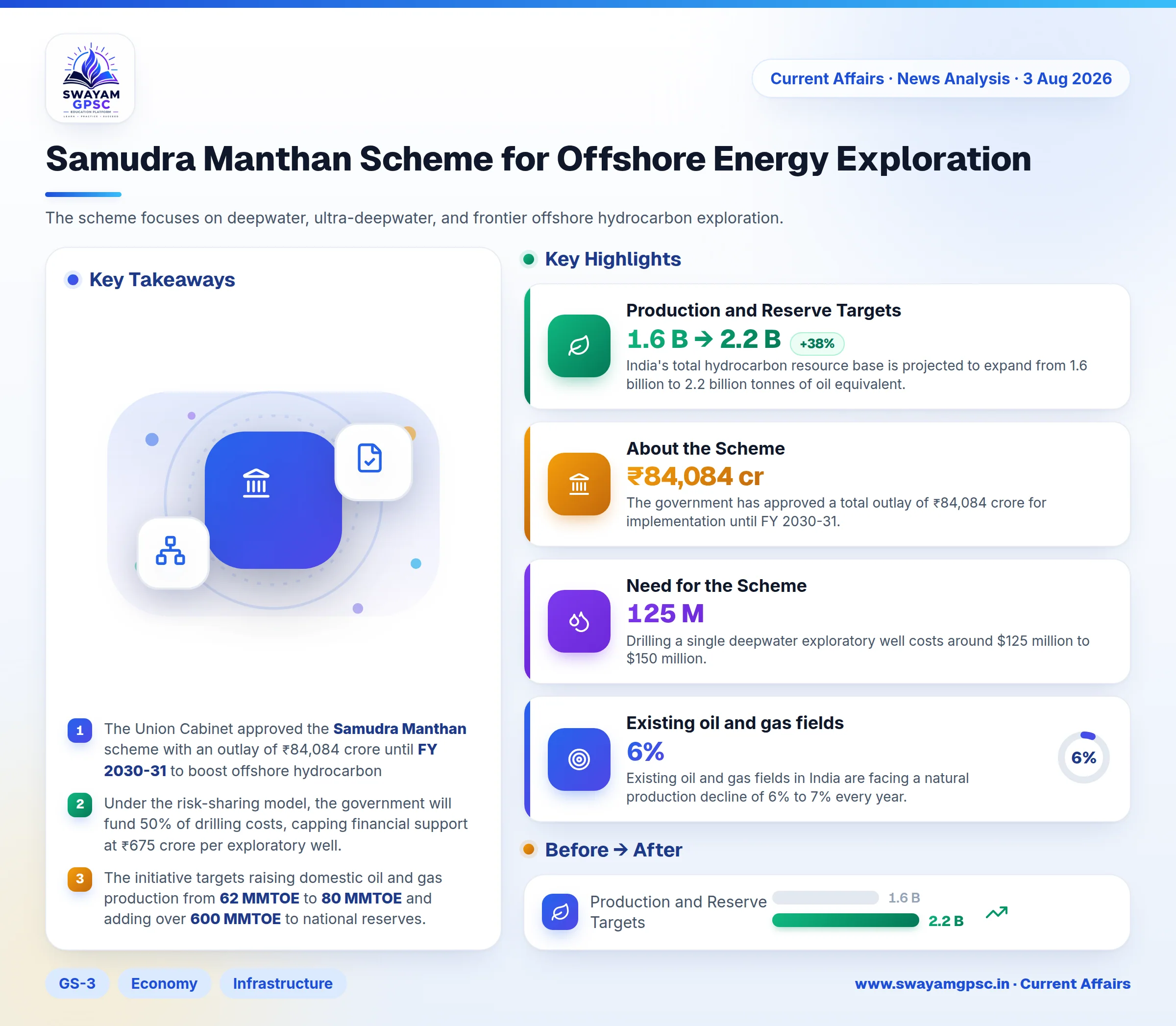
- The Union Cabinet approved the Samudra Manthan scheme with an outlay of ₹84,084 crore until FY 2030-31 to boost offshore hydrocarbon exploration.
- Under the risk-sharing model, the government will fund 50% of drilling costs, capping financial support at ₹675 crore per exploratory well.
- The initiative targets raising domestic oil and gas production from 62 MMTOE to 80 MMTOE and adding over 600 MMTOE to national reserves.
- Successful offshore exploration could cut India's crude oil import bill by nearly ₹1 lakh crore every year.
Why in News
- The Union Cabinet recently approved the Samudra Manthan scheme, also known as the National Offshore Exploration Scheme.
- This scheme aims to fulfill the Prime Minister's vision announced on Independence Day 2025 to tap India's offshore energy reserves.
About the Scheme
- It is a Central Sector Scheme managed by the Ministry of Petroleum and Natural Gas.
- The government has approved a total outlay of ₹84,084 crore for implementation until FY 2030-31.
- The scheme focuses on deepwater, ultra-deepwater, and frontier offshore hydrocarbon exploration.
Need for the Scheme
- Offshore exploration involves high financial risk, massive capital investment, and complex technology with a 5 to 10 year gestation period.
- Drilling a single deepwater exploratory well costs around $125 million to $150 million.
- Existing oil and gas fields in India are facing a natural production decline of 6% to 7% every year.
Key Objectives
- The scheme aims to lower financial risks in offshore exploration and attract private investments.
- It strives to boost domestic oil and gas production, cut down energy import dependence, and ensure national energy security.
- It supports key national initiatives including Viksit Bharat, Make in India, and Atmanirbhar Bharat.
Core Features and Infrastructure
- The scheme funds the collection, processing, and analysis of seismic data across frontier offshore basins.
- It accelerates scientific and exploratory drilling in deepwater and ultra-deepwater regions.
- It sets up shared offshore production networks, an integrated Oil and Gas Manufacturing and Services Zone, and digital management systems.
- It encourages international cooperation, stakeholder engagement, and capacity building.
Financial Allocation
- Out of the total budget, ₹43,200 crore is set aside to drill 60 deepwater exploratory wells.
- The government allocated ₹28,534 crore for acquiring seismic data.
- A sum of ₹10,000 crore is reserved for common offshore infrastructure hubs, while ₹2,000 crore is dedicated to manufacturing and services zones.
Implementation and Risk Sharing
- The government will fund up to 50% of eligible drilling costs, capped at ₹675 crore per well.
- This subsidy reduces financial risk and encourages investments in basins like Krishna-Godavari, Cauvery, Mahanadi, and the Andaman region.
Current Progress
- ONGC plans to drill 150 deepwater wells over seven years to evaluate 5,600 MMTOE of potential hydrocarbon resources.
- Oil India is conducting exploration in the Andaman offshore region and has already found natural gas in Vijayapuram-2 and Vijayapuram-3.
Production and Reserve Targets
- Successful exploration under the scheme is expected to add over 600 MMTOE to India's petroleum reserves.
- Annual domestic oil and gas production is targeted to rise from 62 MMTOE to 80 MMTOE.
- India's total hydrocarbon resource base is projected to expand from 1.6 billion to 2.2 billion tonnes of oil equivalent.
Significance
- The scheme could save nearly ₹1 lakh crore annually in crude oil import bills.
- It will create many skilled jobs, strengthen local manufacturing, and establish a globally competitive offshore energy service sector.