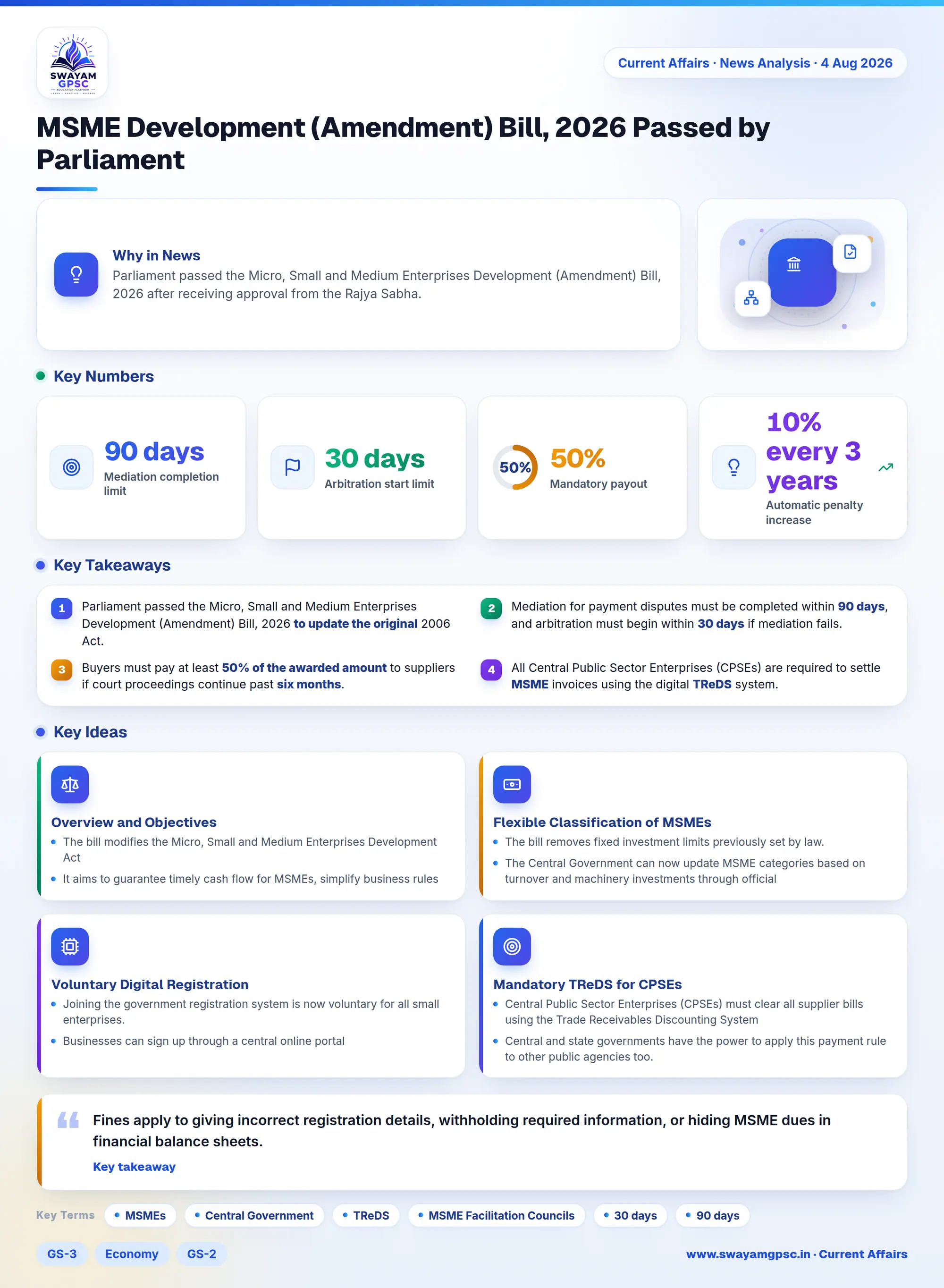
MSME Development (Amendment) Bill, 2026 Passed by Parliament
#GS-3 #Economy #GS-2 #Governance & Social Justice #Good Governance #Current Events #National
Key takeaways
- Parliament passed the Micro, Small and Medium Enterprises Development (Amendment) Bill, 2026 to update the original 2006 Act.
- Mediation for payment disputes must be completed within 90 days, and arbitration must begin within 30 days if mediation fails.
- Buyers must pay at least 50% of the awarded amount to suppliers if court proceedings continue past six months.
- All Central Public Sector Enterprises (CPSEs) are required to settle MSME invoices using the digital TReDS system.
- Minimum monetary fines for regulatory non-compliance will automatically increase by 10% every three years.
Why in News
- Parliament passed the Micro, Small and Medium Enterprises Development (Amendment) Bill, 2026 after receiving approval from the Rajya Sabha.
Overview and Objectives
- The bill modifies the Micro, Small and Medium Enterprises Development Act, 2006 to help small enterprises through quicker bill clearance and simpler legal processes.
- It aims to guarantee timely cash flow for MSMEs, simplify business rules, and encourage growth using digital platforms and legal changes.
Flexible Classification of MSMEs
- The bill removes fixed investment limits previously set by law.
- The Central Government can now update MSME categories based on turnover and machinery investments through official notifications.
Voluntary Digital Registration
- Joining the government registration system is now voluntary for all small enterprises.
- Businesses can sign up through a central online portal, while states can also launch their own digital registration systems.
Mandatory TReDS for CPSEs
- Central Public Sector Enterprises (CPSEs) must clear all supplier bills using the Trade Receivables Discounting System (TReDS) platform.
- Central and state governments have the power to apply this payment rule to other public agencies too.
Time-Bound Mediation
- Mediation proceedings before MSME Facilitation Councils or official mediators must wrap up within 90 days from the first hearing.
Time-Bound Arbitration
- If initial mediation attempts fail, arbitration must begin within 30 days.
- Official arbitration decisions must be announced within 90 days after all legal statements are filed.
Relief During Award Disputes
- Businesses have the option to challenge arbitration decisions and settlement agreements in court.
- If court proceedings drag on beyond six months, the buyer must pay at least 50% of the awarded amount to the supplier.
Decriminalisation of Compliance
- The amendment replaces criminal charges with simple warnings and cash fines for minor compliance errors.
- Fines apply to giving incorrect registration details, withholding required information, or hiding MSME dues in financial balance sheets.
Progressive Penalty Structure
- Repeat rule-breakers will face larger financial penalties for continuous non-compliance.
- Minimum penalty rates will automatically rise by 10% every three years.
Adjudication and Appeals
- The government assigns the Development Commissioner (MSME) as the chief authority to handle penalty cases.
- Disputed decisions from the commissioner can be appealed directly to the MSME Secretary.