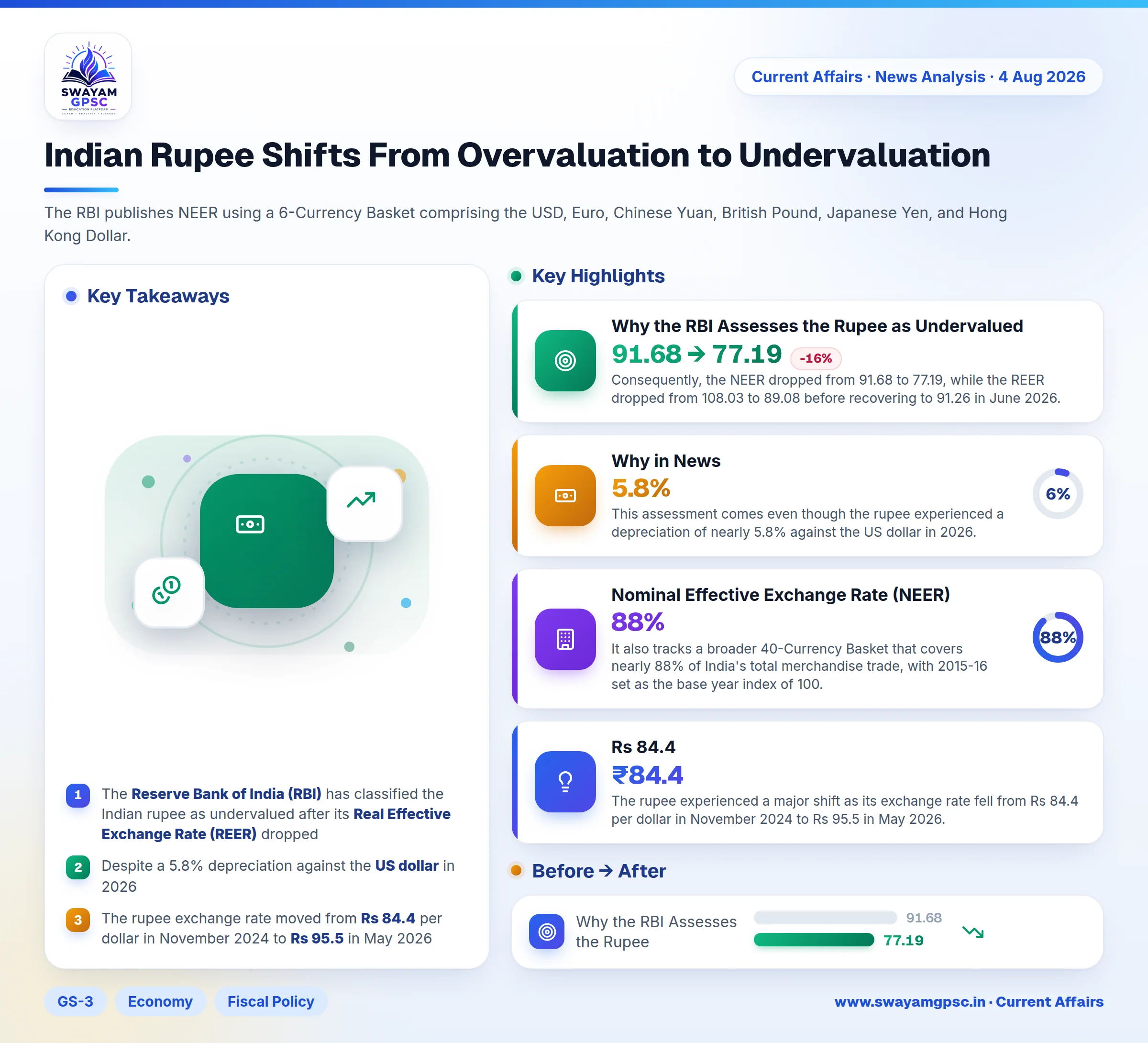
Indian Rupee Shifts From Overvaluation to Undervaluation
#GS-3 #Economy #Fiscal Policy #Monetary Policy #Current Events #National #Exchange Rate #REER
Key takeaways
- The Reserve Bank of India (RBI) has classified the Indian rupee as undervalued after its Real Effective Exchange Rate (REER) dropped to 89.08 in May 2026.
- Despite a 5.8% depreciation against the US dollar in 2026, India maintains GDP growth above 6% and foreign exchange reserves covering over 11 months of imports.
- The rupee exchange rate moved from Rs 84.4 per dollar in November 2024 to Rs 95.5 in May 2026, bringing the currency below its equilibrium benchmark of 100.
- An undervalued currency boosts export competitiveness under Make in India, but it raises the risk of imported inflation and elevates debt servicing costs for External Commercial Borrowings (ECBs).
Why in News
- RBI Governor Sanjay Malhotra announced that the Indian rupee is currently undervalued in both nominal and Real Effective Exchange Rate (REER) terms.
- This assessment comes even though the rupee experienced a depreciation of nearly 5.8% against the US dollar in 2026.
- The RBI clarified that recent currency weakness stems from external global headwinds rather than any weakness in India's macroeconomic fundamentals.
Nominal Effective Exchange Rate (NEER)
- NEER measures the trade-weighted average nominal strength of the rupee against a basket of major foreign currencies without adjusting for inflation.
- The RBI publishes NEER using a 6-Currency Basket comprising the USD, Euro, Chinese Yuan, British Pound, Japanese Yen, and Hong Kong Dollar.
- It also tracks a broader 40-Currency Basket that covers nearly 88% of India's total merchandise trade, with 2015-16 set as the base year index of 100.
- While NEER shows basic currency movements, it fails to account for inflation differences or price levels between trading partners.
Real Effective Exchange Rate (REER)
- REER is the inflation-adjusted version of NEER that measures trade competitiveness by accounting for inflation differentials across trading partners.
- Economists use REER as a reliable proxy to evaluate currency alignment with Purchasing Power Parity (PPP).
- A REER index value above 100 means the currency is overvalued, which makes domestic exports more expensive in foreign markets.
- Conversely, a REER value below 100 indicates an undervalued currency, which theoretically improves export competitiveness abroad.
- A major limitation of REER is that it ignores non-price factors like product quality, logistics efficiency, and technological strength.
- Furthermore, REER focuses heavily on merchandise trade, making it less effective for evaluating India's services-driven export growth.
- India has followed a market-determined managed floating exchange rate regime since March 1993, where the RBI intervenes only to curb extreme volatility.
Why the RBI Assesses the Rupee as Undervalued
- The rupee experienced a major shift as its exchange rate fell from Rs 84.4 per dollar in November 2024 to Rs 95.5 in May 2026.
- Consequently, the NEER dropped from 91.68 to 77.19, while the REER dropped from 108.03 to 89.08 before recovering to 91.26 in June 2026.
- Strong macroeconomic fundamentals support the rupee, including GDP growth above 6%, slowing inflation, and forex reserves that cover over 11 months of imports.
- Global pressures such as high crude oil prices, a strong US dollar, geopolitical conflicts, and Foreign Portfolio Investor (FPI) outflows drove recent rupee losses.
- Because REER sits well below the equilibrium level of 100, the RBI concluded that the recent currency drop went beyond what domestic economic factors justify.
Impact of an Undervalued Rupee on the Economy
- An undervalued rupee makes Indian goods cheaper abroad, which boosts export competitiveness and supports the Make in India initiative.
- It strengthens domestic manufacturers against foreign imports and helps narrow the trade deficit if exports grow faster than imports.
- However, exchange rate advantages alone cannot sustain exports without concurrent gains in manufacturing productivity, logistics, and efficiency.
- On the downside, a weaker currency increases the import costs of crude oil, fertilizers, and electronics, triggering imported inflation.
- It elevates input expenses for import-dependent industries and raises the debt servicing burden for firms with External Commercial Borrowings (ECBs).
- High global oil prices paired with a weak rupee can also widen India's Current Account Deficit (CAD) significantly.
Way Forward
- While global financial volatility causes short-term fluctuations, India's solid macroeconomic base provides a strong foundation for currency stability.
- Maintaining a managed floating exchange rate system, diversifying export sectors, expanding domestic financial markets, and strengthening energy security will protect long-term resilience.