India's Trade Balancing Act: Navigating US, China and Strategic Autonomy
#GS-2 #GS-3 #Governance & Social Justice #Economy #Current Events #International Relations #Trade Policy
Key takeaways
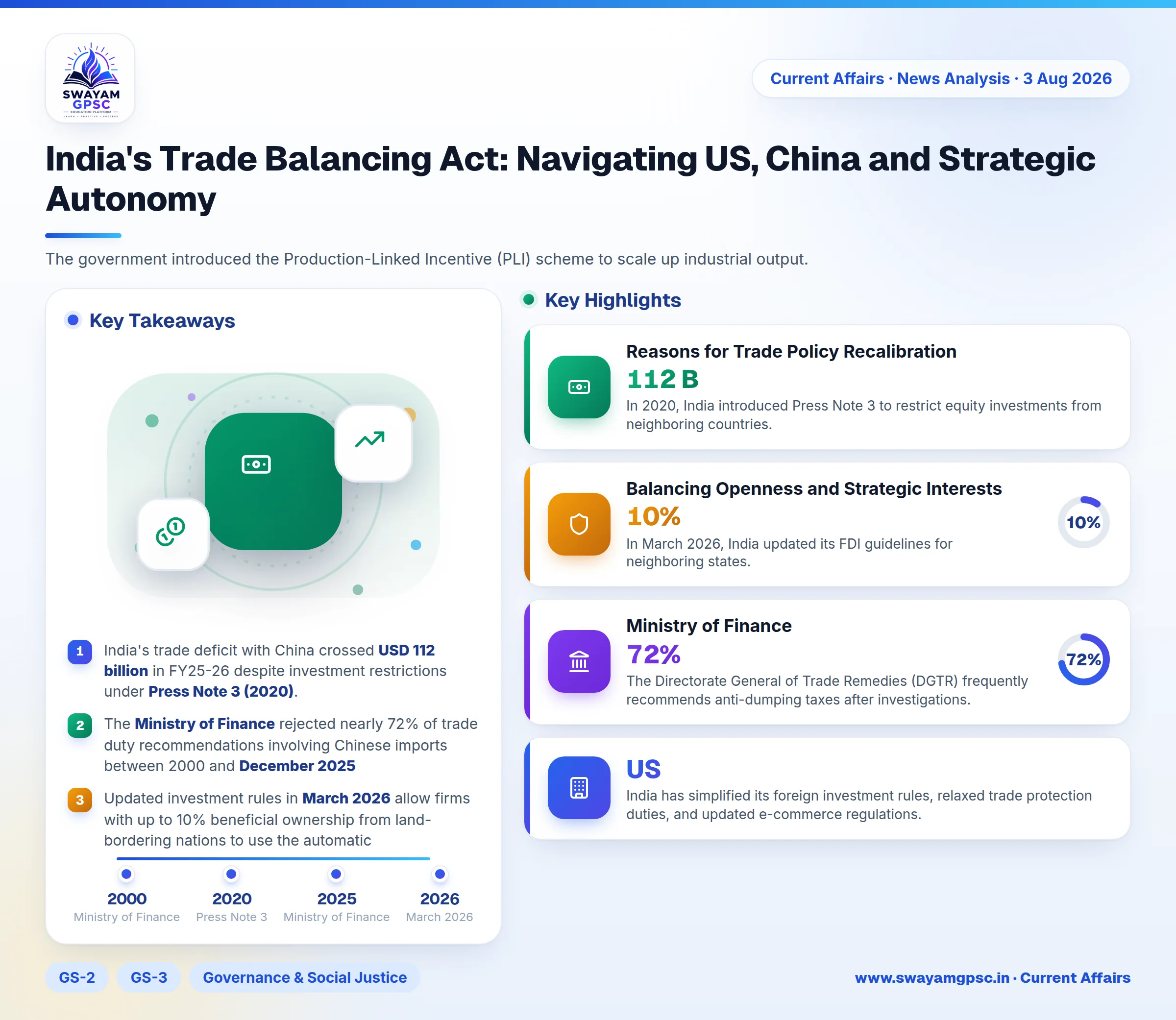
- India's trade deficit with China crossed USD 112 billion in FY25-26 despite investment restrictions under Press Note 3 (2020).
- The Ministry of Finance rejected nearly 72% of trade duty recommendations involving Chinese imports between 2000 and December 2025 to maintain low input costs for domestic exporters.
- Updated investment rules in March 2026 allow firms with up to 10% beneficial ownership from land-bordering nations to use the automatic investment route under strict oversight.
- Policy experts recommend transforming the PLI scheme into Value-Addition Linked Incentives (VALI) to incentivize verifiable growth in domestic manufacturing value.
Why in News
- India has simplified its foreign investment rules, relaxed trade protection duties, and updated e-commerce regulations. The government is taking these actions to attract global capital, expand domestic factories, and increase export growth while maintaining strategic balance with both the US and China.
Background and Policy Overview
- The government is implementing a flexible trade strategy that opens select market areas. By easing rules on Foreign Direct Investment (FDI) and export e-commerce, India wants to attract foreign capital and connect domestic factories with Global Value Chains (GVCs).
- India aims to protect its strategic independence while expanding foreign commerce. Achieving this balance requires boosting local manufacturing depth, keeping trade rules transparent, creating diverse supply routes, and strengthening regulatory agencies.
Reasons for Trade Policy Recalibration
- In 2020, India introduced Press Note 3 to restrict equity investments from neighboring countries. However, this rule did not reduce commercial dependence, as the trade deficit with China crossed USD 112 billion in FY25-26.
- Indian policy planners recognized an important economic reality. Local factories cannot build alternative manufacturing networks without access to Chinese industrial capital and essential raw materials.
- The government introduced the Production-Linked Incentive (PLI) scheme to scale up industrial output. However, local assembly lines require affordable raw materials to stay competitive against foreign rivals.
- High trade duties on Chinese Active Pharmaceutical Ingredients (APIs), electronic parts, and specialty chemicals raised production costs. Consequently, Indian exports lost their price advantage in Global Value Chains (GVCs).
- Mandatory government reviews under Press Note 3 caused long approval delays. This bureaucratic obstacle deterred international venture capital funds that had minor, non-controlling Chinese Limited Partners (LPs).
- India relaxed e-commerce rules for exports and banned products made with forced labor to build goodwill in Washington. These adjustments help Indian exporters negotiate lower US tariffs and secure access to American consumers.
Balancing Openness and Strategic Interests
- In March 2026, India updated its FDI guidelines for neighboring states. Companies with up to 10% beneficial ownership from land-bordering countries can now invest through the automatic route under official supervision.
- This revised policy brings in crucial factory investments while maintaining security checks on major ownership stakes. Meanwhile, India continues to build stronger border security and military readiness along its northern frontiers.
- The Economic Survey 2023-24 highlighted a pragmatic economic strategy. Encouraging Chinese firms to establish local factories creates higher Domestic Value Addition (DVA) than simply importing finished parts.
- Instead of relying on complete import bans, the government now encourages foreign companies to manufacture goods locally under set conditions.
- To help export industries, the state reduced protective taxes on incoming raw materials while keeping import tariffs on finished consumer products. This strategy protects smaller domestic suppliers while supporting large export assembly plants.
- The Directorate General of Trade Remedies (DGTR) frequently recommends anti-dumping taxes after investigations. However, the Ministry of Finance rejected nearly 72% of duty requests on Chinese goods between 2000 and December 2025 to keep factory input costs low.
- India permitted foreign investment in inventory-based e-commerce strictly for export goods. This decision accommodates major American firms like Amazon while protecting domestic shopkeepers from predatory pricing.
Concerns Regarding the Trade Strategy
- Relying heavily on cheap intermediate goods and joint ventures with foreign firms carries security risks. Rival nations could embed their supply networks deep inside India's core industrial sectors.
- This economic pattern risks keeping India as a low-margin assembly hub reliant on basic screwdriver assembly work instead of becoming a self-reliant manufacturing power.
- When the Ministry of Finance rejects protective trade recommendations from the Directorate General of Trade Remedies (DGTR) without public explanation, it creates market confusion. This regulatory uncertainty leaves local chemical and steel producers vulnerable to subsidized foreign dumping.
- Depending on the US for export purchases while relying on China for industrial components creates significant economic vulnerability. Any escalation in trade tensions between Washington and Beijing could disrupt India's financial stability.
- Overriding standard World Trade Organization (WTO) trade defenses draws strong criticism from local business groups. Domestic manufacturers argue that permitting cheap imports damages the goals of Atmanirbhar Bharat and threatens domestic factory jobs.
Way Forward
- Parliament should update the Customs Tariff Act, 1975 to mandate a formal public interest test. The government must publish transparent economic reasons whenever it rejects protective duty proposals from the DGTR.
- The government should restructure the PLI scheme into Value-Addition Linked Incentives (VALI). This reform would reward verified increases in Domestic Value Addition (DVA) and require foreign partners to share technology within defined timelines.
- Customs authorities must enforce digital origin auditing under the CAROTAR, 2020 regulations. Using blockchain tracking will stop foreign suppliers from routing goods through ASEAN countries to evade import taxes.
- India should expand high-tech cooperation through the US-India TRUST Initiative. Partnering on semiconductors and critical technologies with trusted allies like Japan and South Korea will build reliable supply chains.
Conclusion
- India is shifting from basic import protection toward active economic engagement. This balanced strategy safeguards national security while helping domestic companies participate in global supply networks.
- Achieving long-term success requires deepening domestic factory capabilities, maintaining regulatory transparency, and building national technological strength.