India's Private Capex Revival
#GS-3 #Economy #Growth #Infrastructure #Banking #GS-2 #Governance & Social Justice #Government Policies #Current Events #National
Key takeaways
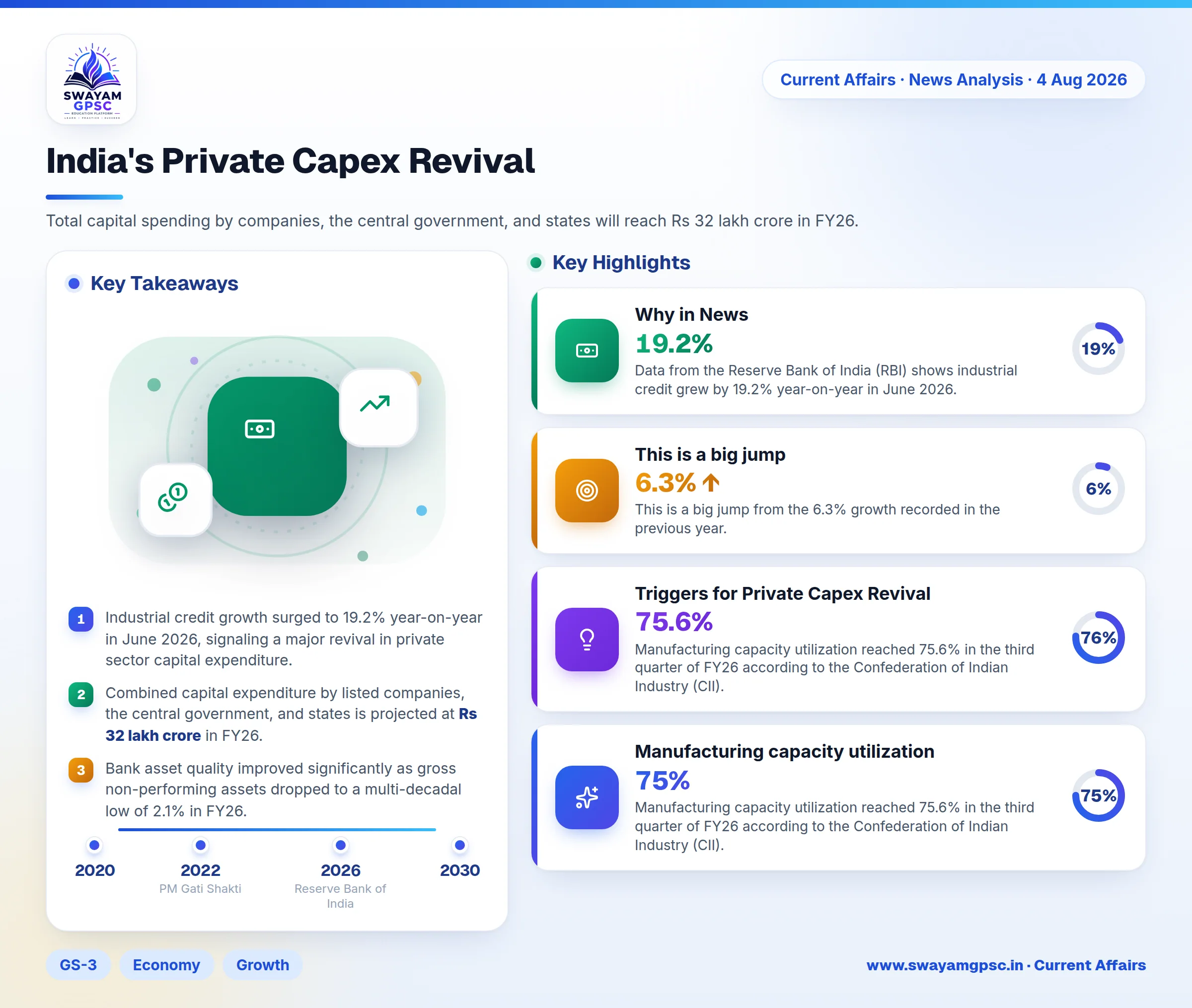
- Industrial credit growth surged to 19.2% year-on-year in June 2026, signaling a major revival in private sector capital expenditure.
- Combined capital expenditure by listed companies, the central government, and states is projected at Rs 32 lakh crore in FY26.
- Bank asset quality improved significantly as gross non-performing assets dropped to a multi-decadal low of 2.1% in FY26.
- Foreign portfolio investors withdrew Rs 2.54 lakh crore from Indian equities by July 2026, highlighting global financial volatility.
- The National Logistics Policy (2022) targets lowering national logistics costs from 13-14% to 8% of GDP by 2030.
Why in News
- Private sector capital investment in India is experiencing a strong recovery after years of slow activity.
- Data from the Reserve Bank of India (RBI) shows industrial credit grew by 19.2% year-on-year in June 2026.
- This is a big jump from the 6.3% growth recorded in the previous year.
- The sharp increase shows that private companies are now driving economic growth alongside government spending.
Summary of Key Drivers and Actions
- India's private capex cycle is seeing a structural revival driven by rising capacity use, healthier balance sheets, credit growth, and policies like the PLI Scheme and PM Gati Shakti.
- Sustaining this momentum requires solving challenges like geopolitical friction, cost escalation, high interest rates, approval delays, and weak rural demand through logistics reforms and financing tools like InvITs and REITs.
Triggers for Private Capex Revival
- Manufacturing capacity utilization reached 75.6% in the third quarter of FY26 according to the Confederation of Indian Industry (CII).
- Crossing the 75% threshold forces companies to build new factories and production lines to meet rising demand.
- Listed companies plan to spend Rs 12.6 lakh crore on capital projects in 2026.
- Total capital spending by companies, the central government, and states will reach Rs 32 lakh crore in FY26.
- Heavy public spending on infrastructure under PM Gati Shakti and the National Infrastructure Pipeline has reduced logistics costs and encouraged private firms to invest.
- Companies are borrowing money to build new greenfield projects rather than just replacing old equipment.
- Credit growth has accelerated in key sectors like textiles, chemicals, petroleum, engineering, and construction.
- The capex-to-depreciation ratio rose to 1.9-2.0x, showing that companies are actively expanding their production capacity.
- The number of large companies investing over Rs 1,000 crore annually rose to 168, up from 91 in 2012.
- Indian companies have healthier balance sheets today because they resolved the twin balance sheet problem of high corporate debt and bad bank loans.
- Corporate new order books expanded by 10.3% year-on-year, while bank credit growth reached 14% in the second half of FY26.
- Government incentive programs like the Production-Linked Incentive (PLI) scheme across 14 sectors are boosting private investments.
- Fast-growing sectors like data centers, solar energy, electric vehicles, and green hydrogen are attracting large new investments.
- Real estate activity and new housing launches in cities are boosting demand for cement and engineering goods.
Comparing Past and Present Capex Cycles
- The previous cycle between 2003 and 2020 suffered from high corporate debt and bad bank loans.
- The current cycle features healthy corporate balance sheets, low debt levels, and strong cash flows.
- Companies previously relied on heavy debt, whereas today they fund growth mainly through internal cash generation.
- Earlier investments focused on basic real estate and traditional industries, but today firms invest in digital tech and clean energy.
- Non-performing bank assets peaked at 11.18% in 2018, but the gross NPA ratio fell to a multi-decadal low of 2.1% in FY26.
- Investments today focus on meeting genuine consumer demand rather than speculative project expansion.
- Modern capex targets advanced technologies like artificial intelligence, semiconductors, defense, and electric vehicles.
Understanding Capital Expenditure
- Capital expenditure refers to funds used by governments or private firms to acquire, maintain, or upgrade long-term physical assets.
- The central government allocated Rs 11.21 lakh crore, or 3.1% of GDP, for capital spending in FY2025-26.
- Revenue expenditure covers daily running costs like salaries, while capital expenditure creates permanent income-generating assets.
- Capital spending includes constructing highways, buying defense equipment, and giving capital loans to states.
- Capital investment creates a strong multiplier effect that boosts demand across many linked industries.
- Gross Fixed Capital Formation (GFCF) grew at a 10% compound annual rate between FY15 and FY24.
- Public capital spending attracts private investment by creating better roads, ports, and power networks.
- Capex accelerates manufacturing and clean energy growth to support the vision of Viksit Bharat 2047.
- Government measures supporting capex include PM Gati Shakti, the National Logistics Policy (2022), and startup credit guarantee schemes.
Challenges
- Global conflicts and trade protectionism disrupt supply chains and increase transport costs through key routes like the Strait of Hormuz.
- High crude oil prices and imported inflation raise raw material costs and cause project budget overruns.
- Higher interest rates and a bank credit-deposit gap of 82.6% in June 2026 increase overall borrowing costs.
- Bureaucratic delays in acquiring land and obtaining environmental permits slow down project execution.
- Weak consumer demand in rural areas and climate risks in agriculture can leave factory capacity unused.
- Foreign portfolio investors pulled out Rs 2.54 lakh crore from Indian stock markets as of July 2026.
- Slow growth in rural bank deposits and loans over the last 25 years threatens long-term factory output.
Way Forward
- Government bodies should empower the Project Monitoring Group (PMG) under DPIIT to clear projects above Rs 500 crore quickly.
- The government should extend credit guarantee support to medium-sized factories and deep-tech startups.
- Expanding the Production-Linked Incentive (PLI) scheme to space technology and defense will drive high-tech manufacturing.
- Reintroducing tax benefits like accelerated depreciation will lower capital costs for companies expanding their factories.
- Implementing the National Logistics Policy (2022) will reduce logistics costs from 13-14% to 8% of GDP by 2030.
- Promoting investment vehicles like InvITs and REITs will help attract private capital for large infrastructure projects.
Conclusion
- India's private investment recovery marks a structural shift toward long-term economic expansion.
- Sustaining this trend through faster reforms will help raise national productivity and create millions of jobs.
- Strong private capex is essential for turning India into a developed nation by 2047.