Enhancing the Effectiveness of Fast-Track Courts in India
#GS-2 #Indian Polity & Constitution #Judiciary #Governance & Social Justice #Good Governance #Indian Society #Women #Vulnerable Sections #Fast Track Courts #POCSO Act
Key takeaways
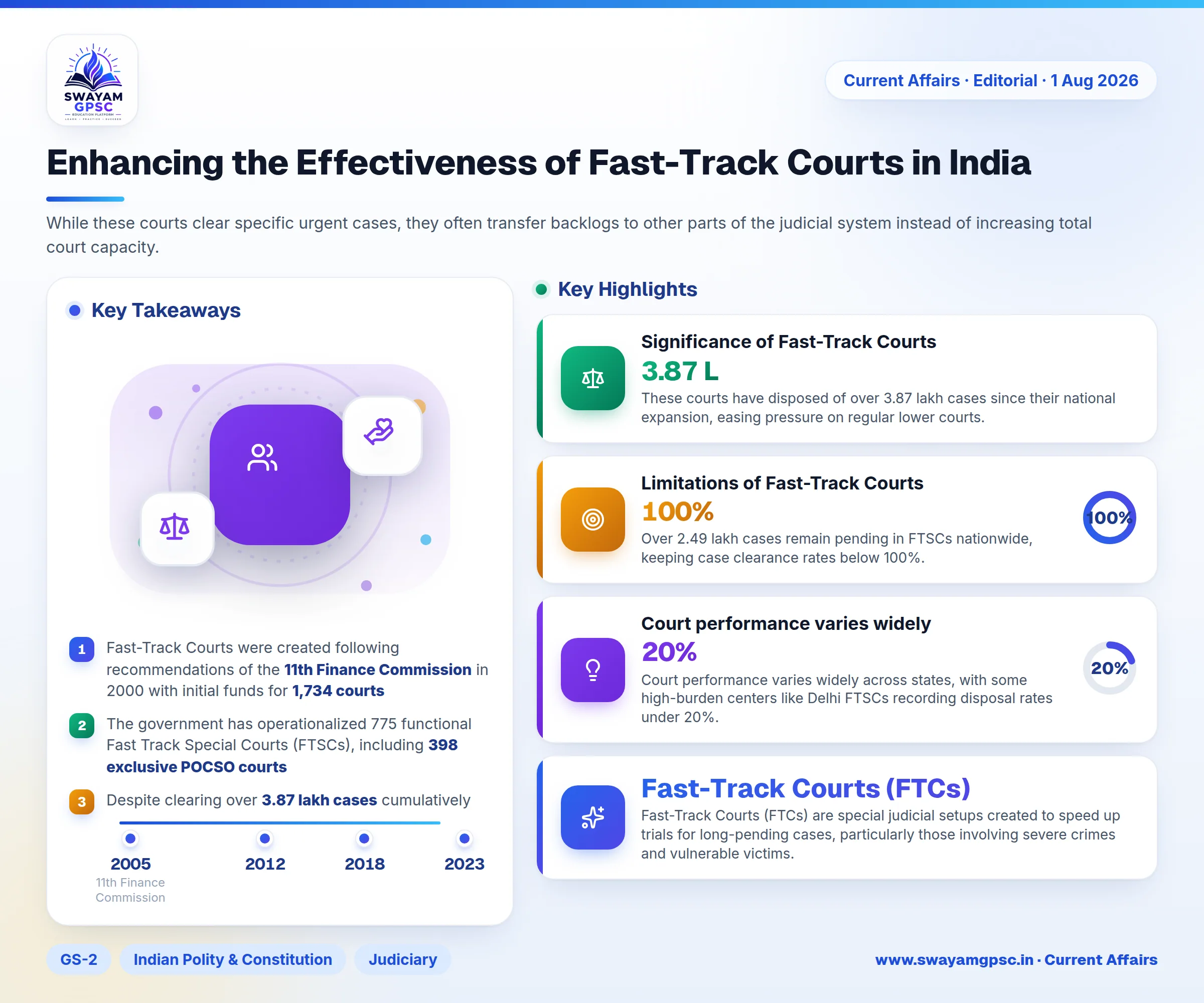
- Fast-Track Courts were created following recommendations of the 11th Finance Commission in 2000 with initial funds for 1,734 courts across India.
- The government has operationalized 775 functional Fast Track Special Courts (FTSCs), including 398 exclusive POCSO courts, funded partly through the Nirbhaya Fund.
- Despite clearing over 3.87 lakh cases cumulatively, FTSCs still face a pendency of over 2.49 lakh cases with case clearance rates remaining below 100%.
- While FTSCs target 41-42 case disposals per quarter, disposal rates in high-burden regions like Delhi have fallen below 20% due to structural bottlenecks.
Why in News
- Fast-track courts help speed up trials for critical offences, but they struggle because of structural problems like shifting judges, lack of infrastructure, and delays in prosecution.
- While these courts clear specific urgent cases, they often transfer backlogs to other parts of the judicial system instead of increasing total court capacity.
What are Fast-Track Courts?
- Fast-Track Courts (FTCs) are special judicial setups created to speed up trials for long-pending cases, particularly those involving severe crimes and vulnerable victims.
- They bypass normal procedural delays to ensure quick trial decisions and lessen the workload of regular district courts.
- The modern plan for FTCs grew after recommendations from the 11th Finance Commission in 2000 and the 12th Finance Commission in 2005.
- In 2000, the central government provided funds to set up 1,734 fast-track courts across India to clear old court backlogs.
- Over time, these courts expanded their focus from general old cases to sensitive matters like crimes against women, children, and senior citizens.
- FTCs aim to protect the constitutional right to a speedy trial under Article 21 of the Constitution.
- They focus on clearing heavy case backlogs in district and sessions courts through continuous focus on sensitive cases.
- They also work to reduce the emotional strain on victims and witnesses by delivering quicker final verdicts.
- Initially set up as temporary bodies, many FTCs are now part of regular courts or statutory systems like Fast Track Special Courts (FTSCs) under the Criminal Law (Amendment) Act, 2018.
- Unlike standard courts that frequently delay hearings, FTCs conduct continuous day-to-day trials until a case concludes.
- Strict procedural rules apply in FTCs to stop lawyers from taking unnecessary trial adjournments.
- Experienced senior judges or retired judicial officers usually head these fast-track courts.
- FTCs prioritize cases involving sexual assault, rape, and violence against women and children.
- They give dedicated attention to child abuse cases under the Protection of Children from Sexual Offences (POCSO) Act.
- They focus on cases involving elderly citizens and vulnerable witnesses who face severe hardship from long legal delays.
- They address trials of undertrial prisoners who have spent long periods in jail, helping reduce prison congestion.
- They also handle selected public corruption and human trafficking cases based on official state notifications.
- The Criminal Law (Amendment) Act, 2018 expanded Fast Track Special Courts (FTSCs) specifically for rape and POCSO Act cases.
- Supreme Court guidelines mandate an FTSC in any district that registers more than 100 FIRs under the POCSO Act.
- FTSCs operate under target disposal rates of about 41-42 cases per quarter, or roughly 165 cases per year.
Pivotal Court Rulings on Fast-Track Courts
- In *State of West Bengal v. Anwar Ali Sarkar (1952)*, the Supreme Court ruled under Article 14 that speed alone cannot justify picking cases for fast trials without objective criteria like crime severity.
- In *Hussainara Khatoon v. State of Bihar (1979)* and *Sheela Barse v. Union of India (1983)*, the Supreme Court established that the right to a speedy trial is a fundamental right under Article 21.
- In *Brij Mohan Lal v. Union of India (2002, 2012)*, the Supreme Court ruled that states cannot suddenly close FTCs and set clear rules for appointing qualified judges.
- In *P. Ramachandra Rao v. State of Karnataka (2002)*, the Supreme Court decided that courts cannot set fixed, rigid time limits for finishing criminal trials.
Significance of Fast-Track Courts
- FTCs deliver on the constitutional right to a speedy trial under Article 21 and prevent long pre-trial jail stays.
- Supported by the Nirbhaya Fund, 775 functional FTSCs including 398 exclusive POCSO courts protect women and children across 29 States and UTs.
- These courts have disposed of over 3.87 lakh cases since their national expansion, easing pressure on regular lower courts.
- Continuous daily trials prevent regular adjournments and stop lawyers from delaying court proceedings.
- Modern FTSCs receive dedicated support teams of seven support staff members to assist each judicial officer.
- Quick trial outcomes in major cases help deter future crimes and build public trust in the legal system.
- Funding through a 60:40 financial sharing pattern between the Centre and States provides targeted money for lower court upgrades.
- FTC procedures match the strict investigation and trial timelines set by the Bharatiya Nagarik Suraksha Sanhita (BNSS), 2023.
Limitations of Fast-Track Courts
- Over 2.49 lakh cases remain pending in FTSCs nationwide, keeping case clearance rates below 100%.
- Delays in recruiting judges leave posts vacant, while shifting existing judges to FTCs causes backlogs in regular courts.
- The India Justice Report highlights that trials stall due to police lacking cyber-forensic skills, DNA profiling tools, and public prosecutors.
- Local judge shortages force many FTC judges to handle routine civil and criminal cases, diluting their primary focus.
- Many district FTCs lack child-friendly spaces required by the POCSO Act, witness protection rooms, and video setup.
- Dependence on temporary extensions of centrally sponsored schemes creates financial uncertainty for long-term court operations.
- Court performance varies widely across states, with some high-burden centers like Delhi FTSCs recording disposal rates under 20%.
- Pressure to hit high case disposal numbers can lead to rushed trials, procedural mistakes, and constitutional issues under Article 14.
Way Forward
- Link FTCs with the Inter-Operable Criminal Justice System (ICJS) and use predictive analytics to plan trial schedules based on witness data and crime patterns.
- Create a dedicated cadre of professional Court Managers to handle administrative tasks so judges can focus entirely on hearings.
- Introduce milestone-based fee systems for public lawyers to discourage unnecessary trial delays and adjournments.
- Use secure video and audio recording for all witness testimonies under standardized protocols to protect evidence from tampering.
- Set up district-level forensic task forces with cyber experts and prosecutors to ensure police chargesheets are legally solid before trial.
- Start shift or weekend courts using current buildings for minor legal matters to double court hours without spending on new construction.
- Place social workers and trauma counselors in courtrooms to support vulnerable victims and reduce witness hostility during trials.
- Evaluate judicial performance using a balanced scorecard that checks trial quality and due process rather than just raw disposal counts.
Conclusion
- Fast-Track Courts offer targeted speed, but lasting success requires fixing deeper issues in court infrastructure, staffing, and police investigations to ensure fair trials for all citizens.