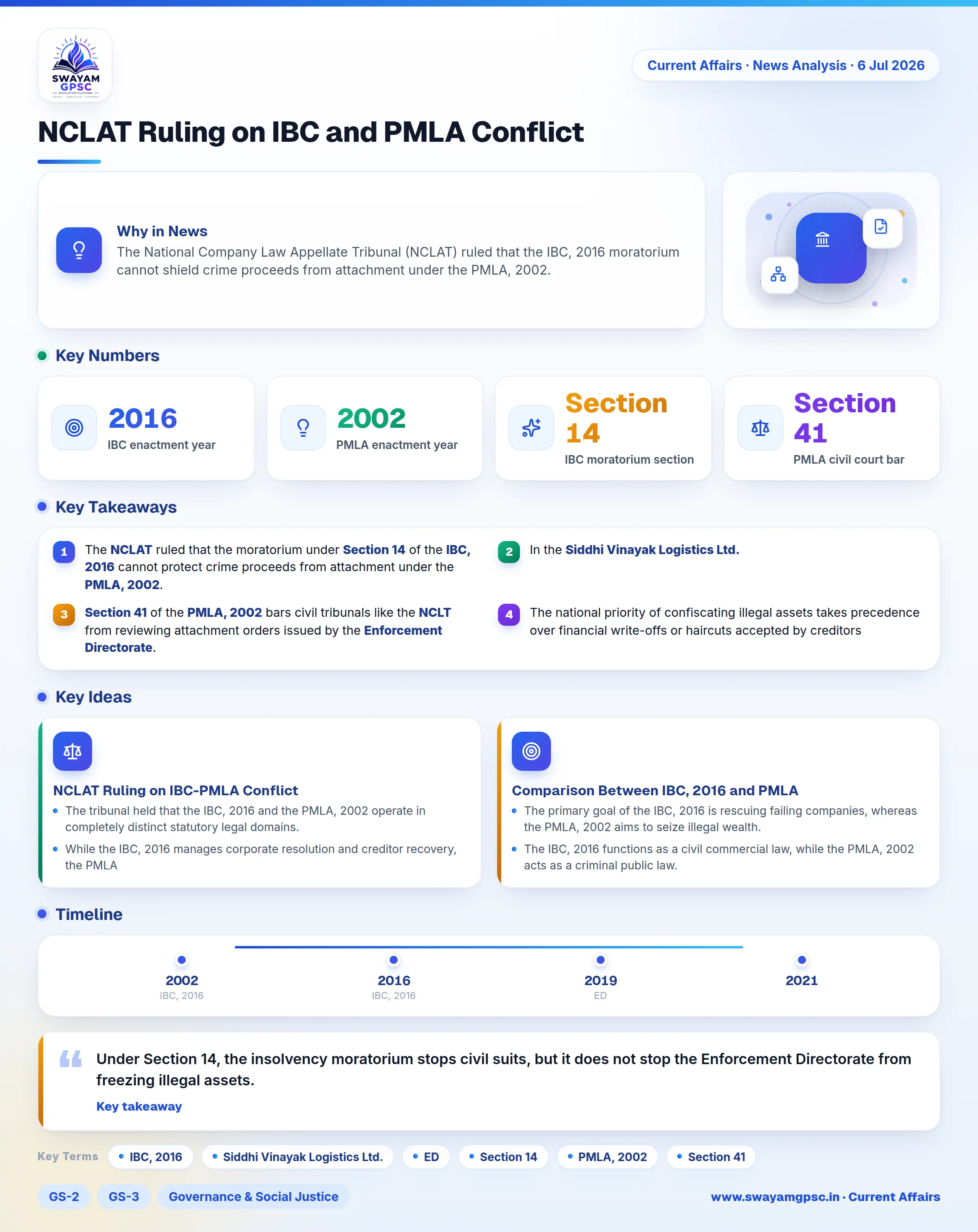
NCLAT Ruling on IBC and PMLA Conflict
#GS-2 #GS-3 #Governance & Social Justice #Economy #Regulatory Bodies #Money Laundering #National
Why in News
- The **National Company Law Appellate Tribunal (NCLAT)** ruled that the **IBC, 2016** moratorium cannot shield crime proceeds from attachment under the **PMLA, 2002**.
- This ruling arose during insolvency proceedings for **Siddhi Vinayak Logistics Ltd.**, where the **Enforcement Directorate (ED)** attached assets despite ongoing resolution process.
- The company liquidator cited the **P. Mohanraj v. Shah Brothers Ispat (2021)** judgment, which prevents coercive recovery actions during the insolvency moratorium.
- In response, the ED cited the **Embassy Property Developments v. State of Karnataka (2019)** case, which limits insolvency tribunals from reviewing decisions made by independent statutory bodies.
NCLAT Ruling on IBC-PMLA Conflict
- The tribunal held that the **IBC, 2016** and the **PMLA, 2002** operate in completely distinct statutory legal domains.
- While the **IBC, 2016** manages corporate resolution and creditor recovery, the **PMLA, 2002** focuses on tracing and confiscating illegal assets.
- The moratorium under **Section 14** of the **IBC, 2016** protects only legitimately acquired assets of a company.
- Public criminal law actions under the **PMLA, 2002** do not create civil debt and cannot be stopped by an insolvency moratorium.
- Furthermore, **Section 41** of the **PMLA, 2002** prevents civil courts from interfering in matters that money laundering authorities decide.
- The NCLAT stressed that national interest in seizing illegal money takes priority over financial haircuts taken by commercial creditors.
- Insolvency tribunals like **NCLT** lack the legal power to challenge attachment orders passed by the **Enforcement Directorate**.
Comparison Between IBC, 2016 and PMLA, 2002
- The primary goal of the **IBC, 2016** is rescuing failing companies, whereas the **PMLA, 2002** aims to seize illegal wealth.
- The **IBC, 2016** functions as a civil commercial law, while the **PMLA, 2002** acts as a criminal public law.
- The **IBC, 2016** protects valid business assets, whereas the **PMLA, 2002** targets tainted property regardless of corporate status.
- Under **Section 14**, the insolvency moratorium stops civil suits, but it does not stop the **Enforcement Directorate** from freezing illegal assets.
- Insolvency matters are decided by the **NCLT** and **NCLAT**, while money laundering issues are handled by designated **PMLA** courts.