Ethanol Blended Petrol Programme in India: Progress, Key Concerns, and Way Forward
#GS-2 #GS-3 #Governance & Social Justice #Government Policies & Interventions #Economy #Infrastructure #Agriculture #Environment #Environmental Pollution & Degradation #Climate Change #Science & Technology #Energy #Current Events #National #Ethanol Blending
Why in News
- India's **Ethanol Blended Petrol Programme** has become a central part of the nation's energy transition strategy and biofuel policy.
- The initiative aims to strengthen energy security, boost farmer income, lower carbon emissions, and encourage the use of domestic renewable fuels.
- Public debate has recently increased over **E20** petrol due to consumer worries regarding vehicle mileage drops, engine durability, and fuel choice.
Summary of Cleaner Mobility Technologies
- Multiple alternative technologies are shaping India's transition toward cleaner road transportation.
- Key cleaner options include ethanol blends, flex-fuel vehicles, hybrid cars, electric vehicles, compressed natural gas, compressed biogas, and green hydrogen.
- Ethanol blending plays a critical role because it cuts crude oil imports, supports domestic farming, and offers a fast, low-cost path to decarbonize transport.
- Achieving long-term success requires scientific testing and clear policies regarding fuel pricing, infrastructure expansion, water sustainability, and engine safety.
Understanding Ethanol and Feedstock Generations
- **Ethanol** is a renewable biofuel produced naturally by fermenting plant sugars with yeast or through synthetic petrochemical processes.
- Distillers in India produce ethanol primarily from **sugarcane molasses**, maize, surplus rice, and damaged food grains.
- **First-generation (1G)** ethanol uses edible crops like sugarcane, corn, and wheat, which can create trade-offs with food security.
- **Second-generation (2G)** ethanol utilizes non-edible agricultural residues like paddy stubble and bamboo, helping reduce farm stubble burning in states like **Punjab** and **Haryana**.
- **Third-generation (3G)** ethanol relies on algae, offering high fuel yields without competing for farm land or fresh water.
- **Fourth-generation (4G)** ethanol uses genetically modified crops designed for high carbon capture, though the technology remains largely theoretical.
Overview of the Ethanol Blended Petrol Programme
- The **Ministry of Petroleum and Natural Gas** runs the **Ethanol Blended Petrol Programme** under the **National Biofuel Policy 2018**.
- The policy seeks to reduce heavy reliance on imported crude oil, cut greenhouse gas emissions, and boost agricultural incomes by creating a steady industrial demand for farm produce.
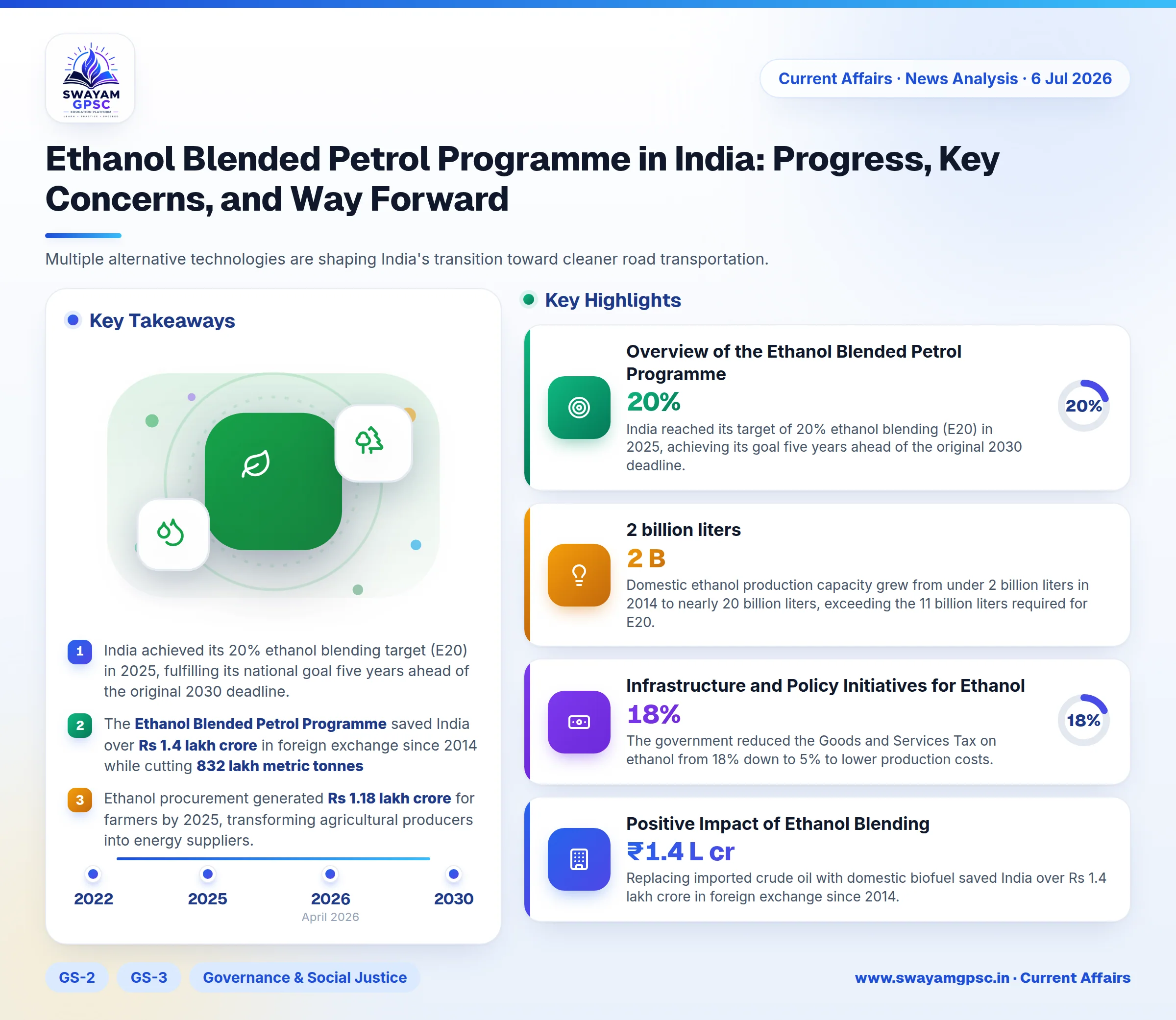
- India reached its target of **20%** ethanol blending (**E20**) in **2025**, achieving its goal five years ahead of the original **2030** deadline.
- All petrol sold across India starting **April 2026** must contain **20%** ethanol and meet a minimum rating of **95 RON**.
- Domestic ethanol production capacity grew from under **2 billion liters** in **2014** to nearly **20 billion liters**, exceeding the **11 billion liters** required for **E20**.
- The **National Biofuel Coordination Committee** oversees feedstock allocation based on national grain and sugar surplus levels.
Infrastructure and Policy Initiatives for Ethanol
- The government introduced the **Ethanol Interest Subvention Scheme** between **2018** and **2022** to support setting up molasses and grain distilleries.
- Public sector oil marketing companies signed **Long-Term Offtake Agreements** with dedicated ethanol plants to provide demand stability and timely payments.
- An **Administered Pricing Mechanism** provided fixed, reliable prices for ethanol to encourage private investment in processing infrastructure.
- The government reduced the **Goods and Services Tax** on ethanol from **18%** down to **5%** to lower production costs.
- Amendments to the **Industries (Development and Regulation) Act 1953** removed regulatory hurdles for moving ethanol across state borders.
Positive Impact of Ethanol Blending
- Replacing imported crude oil with domestic biofuel saved India over **Rs 1.4 lakh crore** in foreign exchange since **2014**.
- Ethanol procurement contributed **Rs 1.18 lakh crore** to farmers and **Rs 1.96 lakh crore** to distilleries by **2025**.
- Guaranteed industrial demand transformed agricultural producers from food providers (**Annadatas**) into energy producers (**Urjadaatas**).
- New processing units generated rural employment opportunities in states like **Uttar Pradesh**, **Maharashtra**, and **Bihar**.
- Oxygenated **E20** fuel ensures complete combustion, cutting total carbon dioxide emissions by approximately **832 lakh metric tonnes**.
- Expanding blending towards **E30** aligns with India's **Panchamrit** climate targets and the goal of achieving **Net-Zero** emissions by **2070**.
- Grain-based production produces **Dried Distillers Grain with Solubles**, a nutrient-rich byproduct used as premium cattle feed within a circular economy.
Challenges
- Fuel efficiency drops slightly with **E20** petrol because ethanol contains less energy per liter than unblended petrol.
- Older vehicles designed for **E10** or lower blends face risk of reduced performance, power loss, or engine wear when running on **E20**.
- Ethanol absorbs water easily, which increases the risk of corrosion in metal, rubber, and plastic components of vehicle fuel systems.
- Fuel stations currently lack separate pumps for **E10**, **E20**, or pure petrol, leaving consumers without choices at the pump.
- Consumers receive no direct price savings on blended fuel, as ethanol carries **5% GST** while petrol faces high Central Excise and State VAT rates.
- Moving beyond **E20** to **E25**, **E30**, or **E100** requires extensive re-engineering, engine calibration, material upgrades, and formal vehicle re-certification.
- Sugarcane-based ethanol requires large amounts of water, sparking concerns regarding local groundwater security and agricultural choices.
Global Examples of Ethanol Adoption
- The **United States** uses **E10** nationwide, expands **E15** availability, and supports a large fleet of flexible-fuel vehicles.
- **Brazil** mandates high ethanol blending ratios, with flexible-fuel vehicles making up over **80%** of new car sales.
- **Japan** follows a phased strategy to introduce **E10** ethanol blends into its transport network.
- Nations like **Canada**, **Thailand**, and several European countries incorporate ethanol blending into their national clean fuel targets.
Way Forward
- Retail fuel stations should offer distinct dispensing options like **E10**, **E20**, **E25**, and **E85** so drivers can select fuel matching their vehicle specs.
- Industry regulators must conduct thorough scientific testing on both new and older vehicles before approving blends above **E20**.
- The government should provide Production Linked Incentive support and tax cuts to encourage mass production of flex-fuel vehicles.
- Automakers and government agencies should develop and subsidize affordable conversion kits to help existing vehicle owners run safely on higher ethanol blends.
- Ethanol sourcing must shift steadily towards non-food feedstocks like maize, paddy stubble, agricultural residues, and **2G** technologies.
- Authorities should establish transparent pricing that shares savings with consumers, set up moisture-controlled storage, and run clear public campaigns on fuel compatibility.
Conclusion
- The **Ethanol Blended Petrol Programme** serves as a core engine for India's clean energy transition and rural economic development.
- Sustaining long-term progress requires addressing consumer concerns through transparent pricing, vehicle safeguards, and sustainable agricultural practices.