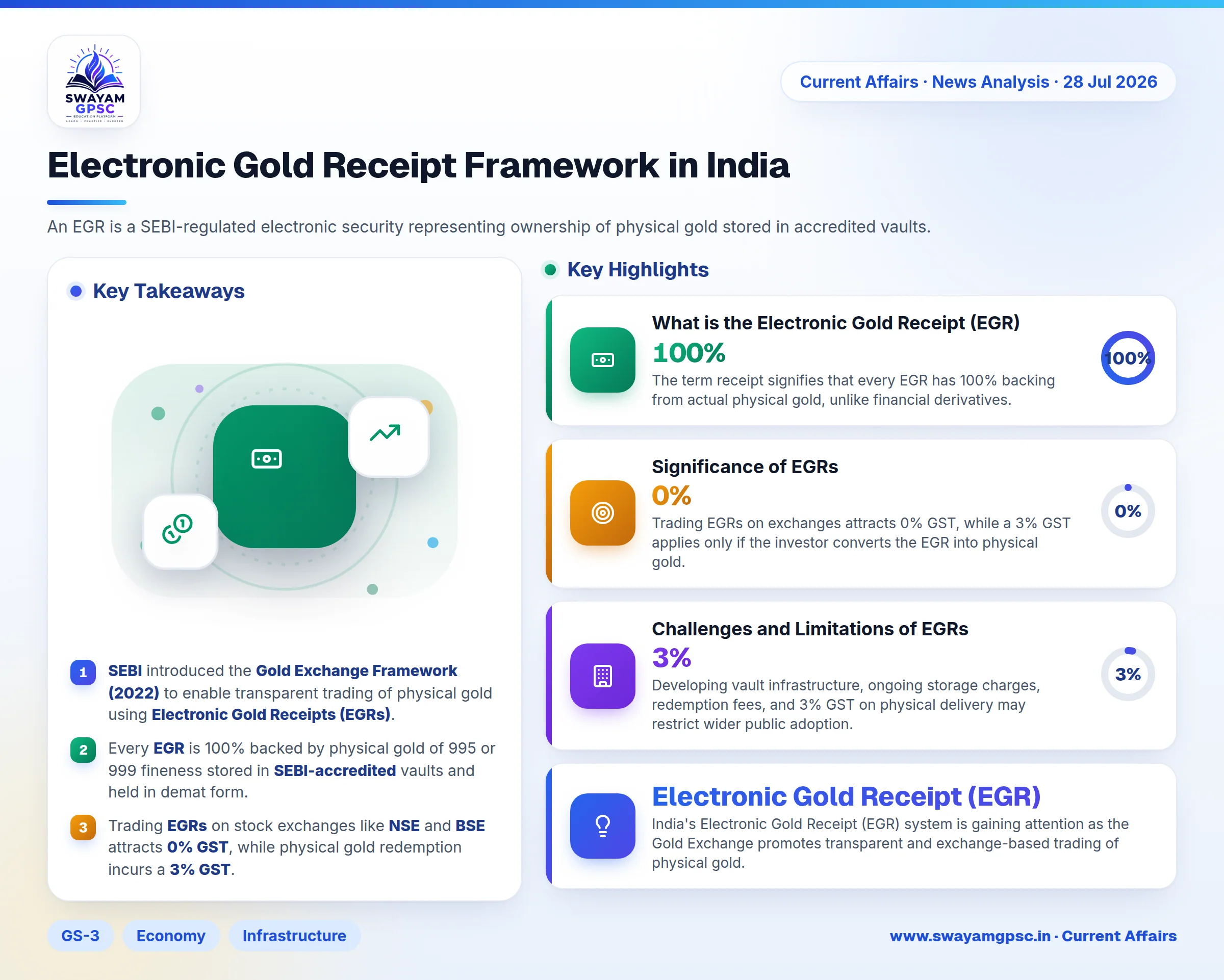
Electronic Gold Receipt Framework in India
#GS-3 #Economy #Infrastructure #Banking #Capital Market #Current Events #National #Electronic Gold Receipt #SEBI
Why in News
- India's **Electronic Gold Receipt (EGR)** system is gaining attention as the Gold Exchange promotes transparent and exchange-based trading of physical gold.
- Digitising gold ownership while allowing physical delivery modernises India's bullion market and increases investor trust.
What is the Electronic Gold Receipt (EGR)
- The **SEBI**-regulated Gold Exchange creates a national platform for trading physical gold in a standardized manner.
- It formalizes India's fragmented gold market and generates a transparent domestic spot price in real time.
- An **EGR** is a **SEBI**-regulated electronic security representing ownership of physical gold stored in accredited vaults.
- Introduced under the Gold Exchange framework in **2022**, **EGRs** allow investors to trade gold electronically on stock exchanges and convert it to physical gold when needed.
- Held in demat form, **EGRs** make gold ownership secure, transparent, and easy to transfer.
- Every **EGR** is fully backed by physical gold of **995** or **999** purity stored with a **SEBI**-registered Vault Manager.
- The term receipt signifies that every **EGR** has 100% backing from actual physical gold, unlike financial derivatives.
- An investor holding an **EGR** becomes the beneficial owner of that gold without needing to store or transport it personally.
Need for the EGR Framework
- **SEBI** introduced the Gold Exchange Framework in **2022** to solve problems like inconsistent purity, opaque prices, and unorganized trading.
- The framework aims to create a regulated national market, enable efficient price discovery, standardize quality, and protect investors through dematerialized gold.
Key Participants in the EGR Ecosystem
- **Vault Managers** store, verify, assay, and deliver physical gold under the **SEBI (Vault Managers) Regulations, 2021**.
- **Depositories** like **NSDL** and **CDSL** maintain **EGRs** electronically in investors' demat accounts.
- **Stock Exchanges** like **NSE** and **BSE** provide the electronic trading platforms for buying and selling **EGRs**.
- **Stock Brokers** facilitate the buying, selling, and redemption requests of **EGRs** for clients.
- **Investors**, including resident individuals, HUFs, NRIs, trusts, and institutions, hold **EGRs** through their demat accounts.
Working of the EGR System
- In Stage I (Creation), eligible gold of **995** or **999** purity is deposited with a **SEBI**-registered Vault Manager, who verifies it and issues **EGRs** to the depositor's demat account.
- In Stage II (Trading), issued **EGRs** are traded on **NSE** and **BSE** with prices linked to the domestic spot market on a **T+1** settlement basis.
- In Stage III (Redemption), investors can redeem **EGRs** for physical gold through their broker, prompting the Vault Manager to deliver gold and cancel the **EGR**.
Significance of EGRs
- **EGRs** replace fragmented jeweller quotes with a single, transparent One Nation, One Price domestic spot price based on real-time market demand.
- A liquid domestic exchange creates an Indian reference price, reducing dependence on international benchmarks like London **LBMA** or Dubai.
- **EGRs** eliminate locker rental costs and theft risks for individual investors because gold is kept in insured, high-security vaults.
- Mandatory purity verification at the vaulting stage eliminates the risk of gold adulteration commonly found in unorganized markets.
- Trading **EGRs** on exchanges attracts **0% GST**, while a **3% GST** applies only if the investor converts the **EGR** into physical gold.
Challenges and Limitations of EGRs
- **EGRs** face challenges like low investor awareness, limited trading volumes, and competition from **Gold ETFs**, digital gold, and **Sovereign Gold Bonds**.
- Developing vault infrastructure, ongoing storage charges, redemption fees, and **3% GST** on physical delivery may restrict wider public adoption.
EGR and India International Bullion Exchange (IIBX)
- The **IIBX** in **GIFT City, Gujarat** is India's first International Bullion Exchange established under the **IFSCA** for international bullion imports and trading.
- While **IIBX** handles the import and supply of standardized physical bullion, **EGRs** facilitate its domestic electronic trading across India.
- Gold imported through **IIBX** can be deposited into **SEBI**-accredited vaults and converted into **EGRs** after meeting purity standards.
Frequently Asked Questions on EGR
- An **EGR** is a **SEBI**-regulated electronic security representing ownership of physical gold held in demat form inside accredited vaults.
- **SEBI** introduced the framework to standardize gold trading, ensure transparent pricing, improve investor protection, and organize the bullion market.
- A **SEBI**-registered Vault Manager verifies, assays, stores, and delivers physical gold while enabling the issuance and cancellation of **EGRs**.
- **IIBX** is regulated by **IFSCA** for international bullion imports, whereas the Gold Exchange is regulated by **SEBI** for domestic **EGR** trading.
- **EGRs** offer transparent pricing, safe demat ownership, guaranteed purity, low storage risks, and easy conversion into physical gold.