Corruption and Indias Governance Challenge
#GS-2 #Governance & Social Justice #Good Governance #Regulatory Bodies #RTI #GS-4 #Ethics #Accountability #Transparency
Why in News
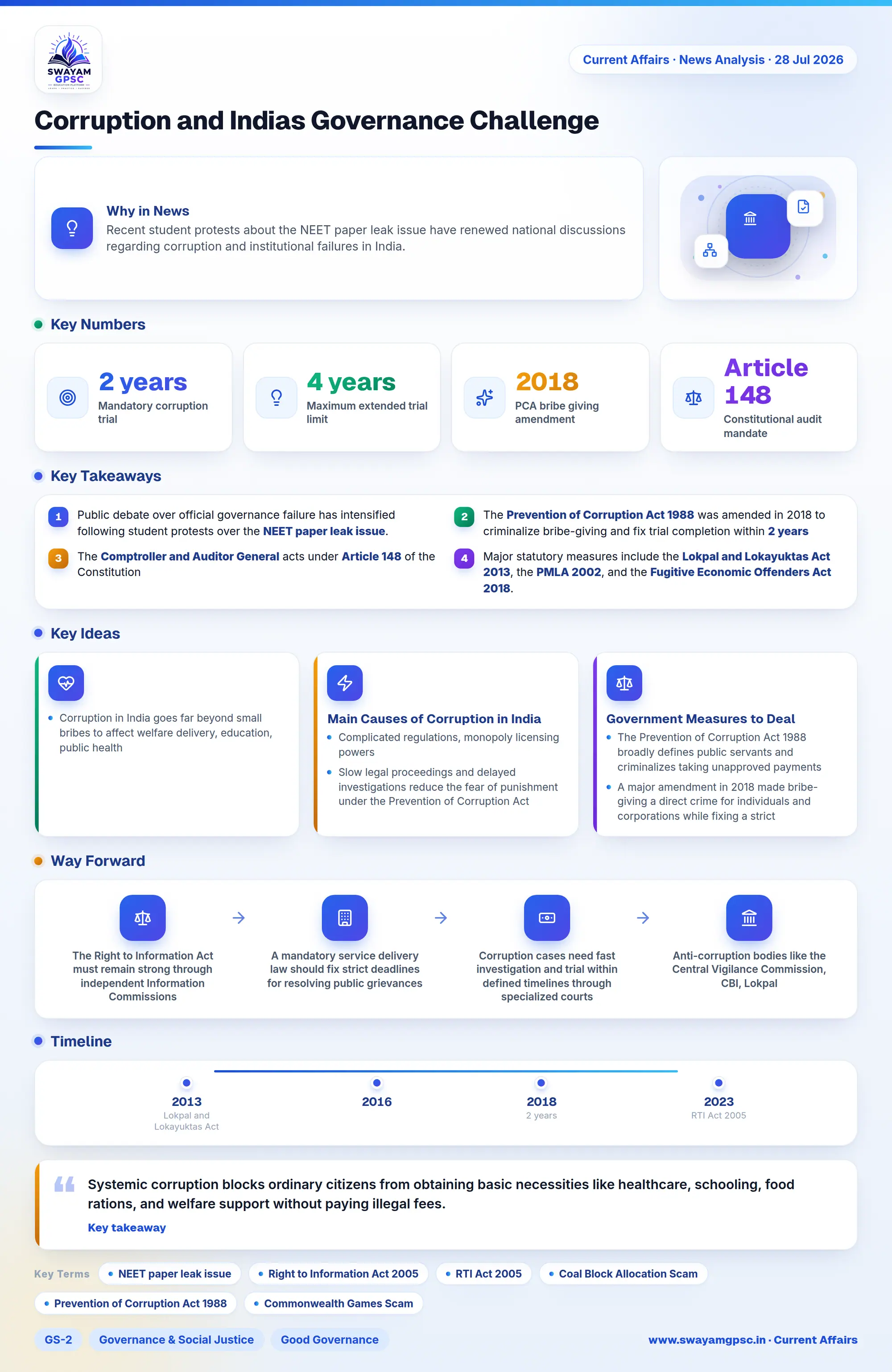
- Recent student protests about the **NEET paper leak issue** have renewed national discussions regarding corruption and institutional failures in India.
- This situation raises serious questions about whether digital platforms, anti-corruption agencies, and the **Right to Information Act 2005** can effectively control official misconduct.
Summary
- Corruption in India goes far beyond small bribes to affect welfare delivery, education, public health, government purchases, political funding, and official accountability.
- While digital services have reduced face-to-face bribery, they have also created new difficulties that can exclude poor and vulnerable citizens.
- The **RTI Act 2005** helps citizens expose official wrongdoings, but recent changes linked to the **Digital Personal Data Protection Act 2023** could reduce government openness.
Main Causes of Corruption in India
- Complicated regulations, monopoly licensing powers, and unguided official discretion create constant opportunities for bribery, as revealed during the **Coal Block Allocation Scam**.
- Slow legal proceedings and delayed investigations reduce the fear of punishment under the **Prevention of Corruption Act 1988**, shown by how the **Fodder Scam** took decades to resolve.
- Secret bidding, inflated project contracts, and weak oversight fuel corruption in public purchases, seen in the **Commonwealth Games Scam**, while welfare schemes suffer from illegal middlemen.
- Delayed safety protections for informants discourage citizens from reporting illegal actions, highlighted by attacks on activists and the murder of **NHAI** engineer **Satyendra Dubey**.
- High political election costs force candidates to rely on secret corporate donations, leading to policy favors and crony capitalism, as highlighted by controversies around the **Electoral Bonds Scheme**.
- Political authority can be misused to favor preferred businesses, distort open market competition, and weaken public anti-corruption protests through cynical political leadership.
Government Measures to Deal with Corruption
- The **Prevention of Corruption Act 1988** broadly defines public servants and criminalizes taking unapproved payments, committing misconduct, or misusing official positions.
- A major amendment in **2018** made bribe-giving a direct crime for individuals and corporations while fixing a strict trial timeline of **2 years**, extendable to **4 years**.
- The **Prevention of Money Laundering Act 2002** helps authorities prevent illegal financial operations and empowers the **Enforcement Directorate** to seize assets linked to corruption.
- The **Lokpal and Lokayuktas Act 2013** set up independent anti-corruption officials at the central level as **Lokpal** and state level as **Lokayukta** to investigate high level public officials.
- The **Fugitive Economic Offenders Act 2018** targets large financial offenders who flee the country by permitting complete asset confiscation even before formal court conviction.
- The **Benami Transactions Prohibition Amendment Act 2016** checks black money by banning property deals where one person holds property paid for by someone else.
- The **Central Vigilance Commission** supervises anti-corruption administration across central government ministries and provides expert guidance on integrity measures.
- The **Right to Information Act 2005** gives citizens access to official public records, breaking administrative secrecy and increasing governance transparency.
Institutional Frameworks
- The **Central Vigilance Commission** operates under the **CVC Act 2003** as an apex integrity body supervising vigilance work and exercising control over the **CBI** for corruption cases.
- The **Central Bureau of Investigation** acts under the **Delhi Special Police Establishment Act 1946** as the chief central agency investigating financial crimes and public sector corruption.
- The **Enforcement Directorate** works under the **PMLA 2002** and **FEMA 1999** within the **Ministry of Finance** to investigate financial laundering and attached criminal properties.
- The **Comptroller and Auditor General** functions under **Article 148** of the Constitution to audit public spending and act as a watchdog over government finances.
Challenges
- Systemic corruption blocks ordinary citizens from obtaining basic necessities like healthcare, schooling, food rations, and welfare support without paying illegal fees.
- Poor and marginalized groups suffer the heaviest burden because they lack money, legal knowledge, and digital tools to deal with complex government systems.
- Unchecked official misconduct damages the independence and public authority of key institutions like the **Judiciary**, **Lokpal**, **CBI**, **ED**, and **Information Commissions**.
- Corruption wastes public funds, distorts healthy market competition, and allows politically connected companies to secure unfair business contracts.
- Delayed court punishments lower public trust in legal systems, leading to popular frustration and encouraging the idea that corruption is a low risk action.
Way Forward
- The **Right to Information Act** must remain strong through independent **Information Commissions**, alongside whistleblower safeguards recommended by the **Second Administrative Reforms Commission**.
- A mandatory service delivery law should fix strict deadlines for resolving public grievances, supported by **Citizens Charters** and the **Sevottam model** to reduce administrative bribery.
- Corruption cases need fast investigation and trial within defined timelines through specialized courts to ensure swift legal punishment for offenders.
- Anti-corruption bodies like the **Central Vigilance Commission**, **CBI**, **Lokpal**, and **Lokayuktas** need administrative independence, adequate funding, and transparent appointments as suggested by the **Santhanam Committee**.
- Political spending requires full digital tracking, public disclosure, and independent auditing, drawing from reforms proposed by the **Dinesh Goswami Committee** and **Indrajit Gupta Committee**.
Conclusion
- Corruption harms Indias growth by destroying institutional trust, misdirecting economic resources, and unfairly hurting underprivileged populations.
- Technology tools and legal rules are useful, but they cannot replace administrative transparency, citizen power, independent agencies, and political honesty.
- India must combine modern technology with strong accountability, strict enforcement of laws, and ethical leadership in public life.